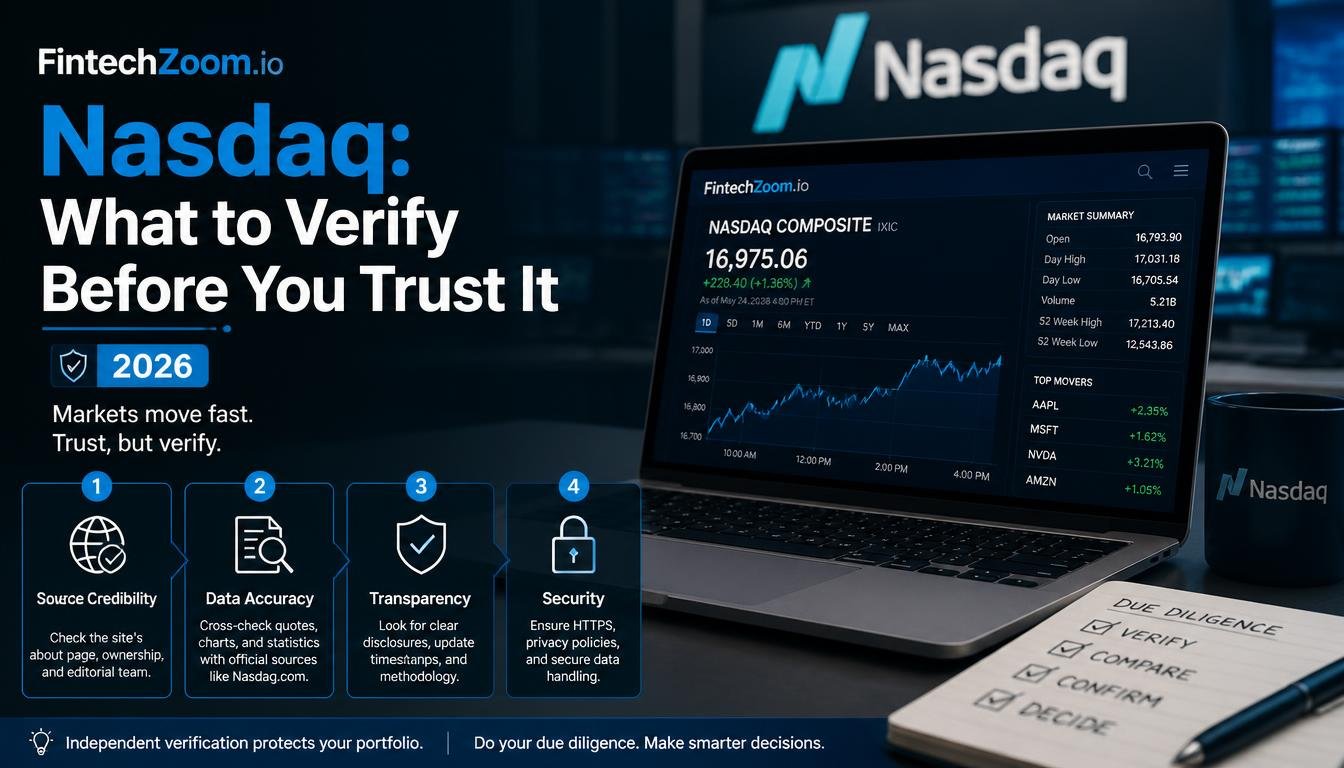
FintechZoom.io Nasdaq: What to Verify Before You Trust It (2026)
Navigating the digital financial landscape in 2026 requires a high degree of skepticism, especially when encountering platforms like FintechZoom.io. Many users searching for real-time data on the Nasdaq index often stumble upon this site, leading to questions about its legitimacy and the accuracy of its reporting.
To understand if the information provided by FintechZoom.io Nasdaq: What to Verify Before You Trust It (2026) is reliable, you must first distinguish between primary financial data providers and third-party aggregators. Verifying the source of your market data is the most critical step in protecting your investment decisions from potentially outdated or misleading insights.
The most direct answer to whether you should trust this platform for your primary trading data is to treat it as a secondary, non-authoritative source. FintechZoom.io functions primarily as a content aggregator rather than a direct data feed from the exchange itself.
If you are looking for real-time, tick-by-tick updates on stocks or market movements, you should always cross-reference their figures with the official Nasdaq market activity page. Relying solely on third-party aggregators for high-stakes financial moves is a risk that most professional traders avoid entirely.
Understanding the Role of Financial Aggregators
Financial aggregators serve as intermediaries that scrape, compile, and present information from various sources to a broader audience. These platforms often package complex market data into simplified articles or dashboards designed for casual retail investors.
While this can be helpful for a quick overview, it introduces a layer of separation between the official exchange and the end-user. This separation is where latency, formatting errors, or even misinterpretations of market events can occur.
When a platform presents information about the Nasdaq, they are typically pulling from a delayed data stream provided by a third-party vendor. This means the price you see on an aggregator might be lagging by 15 or 20 minutes compared to the actual trading floor.
In a volatile market, a 15-minute delay is an eternity that can lead to poor execution and financial loss. Always check the timestamp on any chart or price quote before making a trade based on what you read.
The Mechanics of Data Latency and Accuracy
Data latency is the silent enemy of the retail trader. Official exchanges like the Nasdaq transmit data through high-speed fiber-optic connections directly to institutional terminals.
Aggregators like FintechZoom.io, by contrast, often rely on public APIs or secondary data feeds that are not optimized for millisecond-level precision. This discrepancy is rarely a sign of malice, but it is a fundamental limitation of the technology stack used by many news-focused finance sites.
To verify the accuracy of the data you are seeing, look for a “last updated” indicator on the page. If the site does not explicitly state the time of the last refresh, assume the data is stale.
Furthermore, check if the site distinguishes between “real-time” and “delayed” quotes. Most reputable platforms will include a disclaimer near the price ticker stating that quotes are delayed by at least fifteen minutes, a regulatory requirement for most non-direct exchange data providers.
Regulatory Oversight and Financial Reporting
The financial industry is strictly governed by regulatory bodies that oversee how market information is disseminated to the public. Platforms that provide investment advice or specific trading signals must comply with registration requirements in their respective jurisdictions.
FintechZoom.io operates primarily as a content hub, which often places it outside the scope of the intense regulation applied to broker-dealers or registered investment advisors. This lack of regulatory oversight means there is less accountability for the accuracy of their financial analysis.
When you read an article on such a site, you are reading editorialized content rather than a regulated financial report. Always consider the intent of the writer.
Is the content meant to inform, or is it designed to drive traffic through sensationalized headlines regarding market volatility? If the tone of the article feels alarmist or overly optimistic, it is likely intended for engagement rather than providing a balanced, objective view of the market.
See More: Cloud Application Development Services 2026 Full Guide
Comparing Data Sources for Investors
To provide a clearer picture of where different platforms stand in terms of reliability, it is helpful to look at how they handle market data. Professional traders prioritize speed and direct access, while casual observers may prioritize ease of use and accessibility. The following table highlights the common differences between these types of data sources.
| Feature | Official Exchange (Nasdaq) | Major Financial Portals | Aggregator Sites |
|---|---|---|---|
| Data Latency | Real-time (0ms) | Minimal (seconds) | Delayed (15+ minutes) |
| Regulatory Status | Fully Regulated | High Compliance | Minimal/News-focused |
| Accuracy | Absolute | High | Variable |
| Primary Purpose | Market Integrity | Brokerage/Analysis | Traffic/Content |
Common Red Flags in Financial Content
When evaluating the credibility of a finance-focused website, certain red flags should immediately trigger caution. A lack of transparent authorship is one of the most significant indicators of potential misinformation.
If articles are written by “staff” or lack a clear editorial policy, it becomes difficult to hold anyone accountable for factual errors. High-quality financial journalism almost always provides clear attribution and cites reliable sources for every claim made.
Another warning sign is the use of “clickbait” titles that promise guaranteed returns or secret strategies for beating the Nasdaq index. No legitimate financial news source will promise consistent, high-percentage returns based on proprietary analysis.
If an article suggests that a specific stock is a “must-buy” based on a trend identified by an aggregator, treat it as marketing material rather than objective financial advice. Always perform your own due diligence before committing capital.
The Importance of Independent Analysis
Relying on a single source for your financial information is a dangerous strategy. Even if a site is generally accurate, it will inevitably have blind spots or biases.
A healthy investment strategy involves cross-referencing information across multiple, independent channels. For example, if you see a headline about a major tech stock on an aggregator, search for that same news on multiple reputable outlets to see how they report the facts.
Independent analysis also involves looking at the raw data yourself. Learning how to read a financial statement or track a stock chart on a professional-grade platform will make you less dependent on the summaries provided by others.
When you have the skills to interpret the data, you no longer need to rely on the interpretations offered by third-party sites. This independence is what separates successful, long-term investors from those who chase market trends based on headlines.
Developing a Personal Verification Checklist
To keep your research organized, create a simple checklist you can use every time you visit a new financial site. This process will help you filter out noise and focus on what truly matters for your portfolio.
A good verification process should include checking the date of the article, the primary source of the data, and the reputation of the author. If a site fails any of these checks, it should be relegated to the bottom of your list of resources.
* Check the publication date: Is the news current or yesterday’s market history?
* Identify the data source: Is it a direct feed or a third-party calculation?
* Look for disclosures: Are there clear disclaimers regarding the accuracy of the data?
* Verify author credentials: Does the writer have a background in finance or journalism?
* Cross-reference facts: Do other major outlets report the same figures?
Maintaining Perspective on Market Volatility
Market volatility is a natural feature of the Nasdaq, not a sign that you need to follow every minute-by-minute update. Many aggregator sites capitalize on fear and urgency to keep users refreshing the page.
By understanding that short-term fluctuations are often just “noise,” you can reduce your reliance on sites that prioritize this kind of content. Focus on long-term trends and fundamental performance metrics instead.
When you detach your emotional state from the constant stream of updates, you make better decisions. You will find that you spend less time worrying about what a site says and more time analyzing the underlying health of the companies you have invested in. This shift in mindset is the single most effective way to handle the information overload that characterizes the modern digital financial environment.
Frequently Asked Questions
Is FintechZoom.io a reliable source for real-time stock prices?
No, it is not considered an authoritative source for real-time market data. Like many similar websites, it often uses delayed data feeds, which can be 15 minutes or more behind the actual exchange time. You should always use the official exchange website or a regulated brokerage platform for real-time trading decisions.
Why does the data on aggregator sites sometimes differ from my brokerage app?
The difference usually comes down to the source of the data feed and the latency involved. Brokerage apps typically pay for premium, low-latency feeds to ensure their users have the most accurate information. Free aggregator sites, on the other hand, often use cheaper, delayed feeds to keep their operating costs low.
Should I base my investment strategy on articles found on financial news sites?
You should never base an investment strategy solely on articles from news sites, especially those that focus on aggregation. These articles are often intended for general information rather than personalized financial advice. Always supplement your research with primary sources like SEC filings and company earnings reports.
How can I tell if a financial news website is trustworthy?
Trustworthy sites are transparent about their editorial team, provide clear citations for their data, and clearly distinguish between news and opinion. They also provide prominent disclaimers about the risks of investing. If a site lacks these features, it is best to view its content with a high level of skepticism.
Why is it risky to rely on third-party aggregators for Nasdaq data?
The primary risk is data latency, which can lead to poor execution of trades. Additionally, there is a risk of data errors or misinterpretations that are not caught by the site’s editorial process. In the world of finance, even a small error in data can lead to significant losses if you act on it.
Final Thoughts on Digital Financial Literacy
Maintaining a critical eye toward the information you consume is essential for success in the 2026 market environment. While platforms like FintechZoom.io can provide a convenient way to scan headlines, they should never replace rigorous, primary-source research. By understanding the limitations of aggregators and prioritizing official data sources, you protect yourself from the pitfalls of stale or inaccurate reporting.
Always remember that your financial health depends on the quality of your information. Take the time to verify, cross-reference, and think independently before you make any move with your capital. Your discipline in this area will pay off far more than any tip or headline ever could.
One Comment