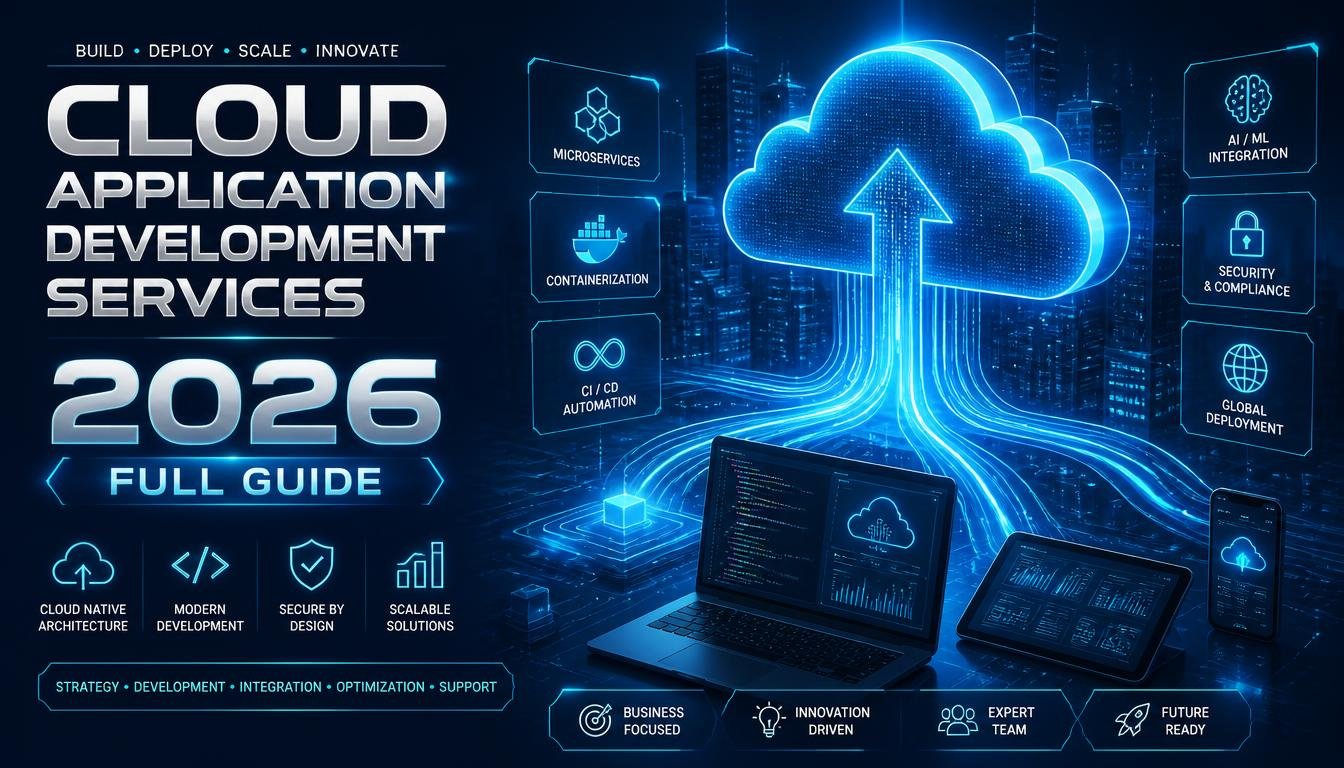
Cloud Application Development Services 2026 Full Guide
Navigating the transition to modern infrastructure requires a deep understanding of current industry standards. This Cloud Application Development Services 2026 Full Guide provides the technical roadmap and strategic insights necessary for building high-performance software in an evolving digital ecosystem. By focusing on cloud-native methodologies and scalable architecture, businesses can ensure their digital assets remain resilient, cost-effective, and secure.
Whether you are migrating legacy systems or launching a new product, the following analysis breaks down the essential components of modern development. You will learn how to optimize your resource allocation and leverage emerging technologies to gain a competitive edge in the coming year.
Core Principles of Cloud-Native Architecture
Modern software engineering centers on the concept of cloud-native design. This approach prioritizes containers, microservices, and dynamic orchestration to maximize agility. Developers no longer treat the cloud as a simple hosting environment; they view it as the primary operating system for their code.
By decoupling services, teams can deploy updates independently without downtime. This modularity is the foundation of the Cloud Application Development Services 2026 Full Guide, as it enables faster time-to-market for complex features.
The Shift Toward Microservices
Microservices allow developers to break down monolithic applications into smaller, manageable pieces. Each piece functions as an independent unit that communicates via APIs. If one service encounters a bottleneck, it does not necessarily crash the entire system.
This isolation is vital for maintaining uptime in high-traffic environments. Furthermore, individual services can be scaled based on demand, which optimizes infrastructure usage and reduces overall waste.
Containerization and Orchestration
Containers encapsulate code and dependencies, ensuring that an app runs consistently across different environments. Tools like Kubernetes have become the industry standard for managing these containers at scale. By automating the deployment, scaling, and operation of application containers, organizations avoid the pitfalls of manual configuration.
This consistency is critical for maintaining stability as your user base grows. It effectively bridges the gap between development and operations teams.
Strategic Infrastructure Selection
Choosing the right provider significantly impacts your long-term operational costs and performance. Major platforms offer distinct advantages depending on your specific workload requirements. While AWS, Google Cloud, and Microsoft Azure dominate the market, your decision should hinge on technical compatibility and regional availability.
You must evaluate these providers based on their managed service offerings rather than just raw storage capacity. A well-chosen infrastructure minimizes the need for extensive manual maintenance.
Comparing Major Cloud Providers
Selecting a platform involves analyzing the trade-offs between proprietary tools and open-source compatibility. Some providers offer integrated AI and machine learning services that can accelerate development if your app requires advanced analytics.
Conversely, others provide more affordable entry points for startups that need to manage strict budgets. The table below outlines key considerations for evaluating these major service providers.
Read More: FintechZoom.io Nasdaq: What to Verify Before You Trust It (2026)
| Provider | Primary Strength | Best Use Case |
|---|---|---|
| AWS | Market Breadth | Enterprise-scale global applications |
| Azure | Microsoft Integration | Organizations using .NET and SQL Server |
| Google Cloud | Data & AI Tools | Big data processing and machine learning |
Security and Compliance Standards
Security in the cloud is a shared responsibility between the provider and the client. While the provider secures the physical hardware and underlying network, you are responsible for securing your application code and data. Implementing a “Zero Trust” model has become mandatory for modern development teams.
This means every request, whether internal or external, must be verified before access is granted. Encryption at rest and in transit should be standard practice for every cloud-based project.
Managing Compliance Requirements
Regulations such as GDPR and HIPAA impose strict requirements on how data is handled and stored. Developers must incorporate these compliance checks directly into the CI/CD pipeline. Automated security testing can identify vulnerabilities before they reach production.
By integrating security into the early stages of the lifecycle, you significantly reduce the risk of costly data breaches. Protecting user information is not just a legal requirement but a fundamental aspect of maintaining customer trust.
Cost Optimization Strategies
Managing the cost of cloud services is a constant challenge for engineering managers. Pay-as-you-go pricing models can lead to unexpected bills if resource allocation is not strictly monitored. Implementing tagging strategies allows you to track spending by department, project, or environment.
This granularity makes it easier to identify underutilized resources that can be downsized or decommissioned. Proactive cost management prevents the “bill shock” that often plagues rapidly scaling companies.
Leveraging Reserved Instances
Reserved instances offer significant discounts in exchange for long-term commitment to specific resources. If your application has predictable baseline traffic, you can save substantially by opting for these plans. Spot instances provide even deeper discounts for non-critical, fault-tolerant workloads.
However, these can be reclaimed by the provider at short notice. Balancing your portfolio between on-demand, reserved, and spot instances is the hallmark of a mature cloud strategy.
The Role of Data Management
Data is the lifeblood of any modern application, and its storage architecture determines performance. You must choose between relational databases for structured data and NoSQL options for flexible, unstructured datasets. Many cloud applications now use a hybrid approach to handle different types of data efficiently.
Scalability is achieved by partitioning data across multiple regions, which also enhances disaster recovery capabilities. A robust data strategy ensures that your app remains responsive even under heavy load.
Automating Data Backups
Automated backups and point-in-time recovery are essential for protecting against accidental data loss. Cloud providers offer native tools that handle these tasks with minimal configuration. You should regularly test your recovery procedures to ensure that your data can be restored within an acceptable timeframe.
In the event of a system failure, the ability to quickly return to a known good state is a critical business continuity requirement. Always prioritize data integrity when designing your storage layers.
CI/CD Pipelines and Automation
Continuous Integration and Continuous Deployment (CI/CD) pipelines are the engine of modern development. They automate the testing, building, and deployment of code updates. By reducing manual intervention, you minimize the risk of human error during releases.
A reliable pipeline ensures that every code change is validated against a suite of tests before reaching the end user. This creates a culture of rapid iteration where feedback loops are shortened significantly.
Standardizing Deployment Workflows
Standardization across teams helps maintain consistency and simplifies troubleshooting. Developers should use infrastructure-as-code tools to define their environments, making them version-controlled and reproducible. This eliminates the “it works on my machine” problem entirely.
When an environment is defined in code, you can spin up or tear down infrastructure with a single command. This level of automation is essential for scaling complex software projects in 2026.
Choosing the Right Development Partner
Many organizations choose to work with specialized firms to accelerate their cloud migration journey. A reputable partner brings industry-specific expertise that can save months of trial and error. Before selecting a firm, review their portfolio for projects that mirror your technical requirements.
Ask about their experience with specific cloud-native tools and their approach to long-term maintenance. Transparency regarding their methodology is a strong indicator of a reliable partner.
Key Factors in Selection
- Technical proficiency with modern container orchestration tools.
- Experience in implementing multi-cloud or hybrid-cloud architectures.
- Proven track record of maintaining high-security standards.
- Clear communication protocols for project management.
- Ability to provide post-launch support and optimization services.
Future Trends in Cloud Development
The landscape of software engineering is shifting toward greater levels of abstraction. Serverless computing, where the provider handles all infrastructure management, is becoming increasingly popular. This allows developers to focus exclusively on writing code, significantly reducing the operational burden.
Additionally, edge computing is bringing processing power closer to the end user to reduce latency. Staying informed about these trends is vital for anyone using this Cloud Application Development Services 2026 Full Guide to plan their long-term roadmap.
The Impact of Artificial Intelligence
AI is transforming how we write, test, and monitor code. Intelligent assistants can now suggest optimizations or identify security flaws in real-time. These tools are becoming integrated into standard IDEs and cloud platforms.
Embracing these advancements will allow your team to produce higher-quality software with less manual effort. The goal is to maximize the efficiency of human developers by offloading repetitive tasks to AI-driven systems.
Frequently Asked Questions
What is the biggest challenge in cloud application development?
The biggest challenge is managing complexity as the system grows. Balancing security, cost, and performance requires continuous monitoring and a disciplined approach to architecture. Teams often struggle with “cloud sprawl,” where unmanaged resources accumulate and drive up costs unnecessarily.
How does serverless computing change the development process?
Serverless computing removes the need to manage virtual machines or container clusters. You write functions that trigger based on specific events, and the cloud provider handles all scaling. This shifts the focus from infrastructure management to pure business logic development.
Is multi-cloud strategy better than a single-provider approach?
A multi-cloud strategy prevents vendor lock-in and can increase resilience. However, it significantly increases operational complexity and requires specialized skills. For most organizations, mastering one platform is more effective than spreading resources across three or four.
How can I ensure my cloud app is secure?
Implement the principle of least privilege, use strong encryption, and automate your security patching. Regularly perform penetration testing to find weaknesses in your configuration. You can find more detailed security frameworks through the National Institute of Standards and Technology, which provides comprehensive guidelines for cybersecurity.
What is the difference between IaaS, PaaS, and SaaS?
IaaS provides the raw infrastructure like virtual machines and storage. PaaS offers a platform for developers to build and deploy applications without worrying about the underlying OS. SaaS delivers finished applications directly to end users over the internet.
Strategic Implementation
Applying the insights from this Cloud Application Development Services 2026 Full Guide requires a commitment to continuous learning. Technology moves quickly, but the core principles of modularity, security, and automation remain constant.
Start by auditing your current infrastructure to identify areas where you can shift toward more cloud-native patterns. Small, iterative improvements are often more successful than massive, high-risk migrations.
By focusing on scalable architecture and automated workflows, you set your organization up for long-term success. Engage with your development team to ensure everyone understands these modern standards and shares the goal of building resilient systems.
As you refine your processes, you will find that the cloud becomes a powerful catalyst for innovation rather than just a hosting cost. Keep monitoring your performance metrics and adapt your strategy as new tools emerge throughout the year.




One Comment